When psychiatrists evaluate an EHR, the checklist is usually the same:
- Documentation templates
- E-prescribing
- Scheduling
- Telehealth
- Patient portal
- Measurement-based care
- Reporting
On paper, most systems claim to offer all of this.
In reality, very few deliver it in a way that actually supports how a psychiatry practice operates, especially once you move beyond a solo provider into a multi-provider, insurance-based model.
This is where the gap starts to show.
The Core Problem: Fragmented Systems in Behavioral Health EHRs
Most behavioral health EHR platforms, including many mental health EHR software solutions, were not designed as operational systems. They are documentation tools with add-ons.
What that leads to:
- Documentation exists separately from billing
- Scheduling is disconnected from clinical workflow
- Measurement-based care is bolted on, not integrated
- Revenue cycle issues surface after claims are submitted
- Providers carry the burden of figuring it out across systems
For a psychiatrist running or joining a growing practice, this creates friction everywhere.
To understand how system gaps impact performance, see how structural instability in behavioral health practices is reshaping operations.
What a Psychiatry-Centered Behavioral Health EHR Should Actually Do
If you look at the workflow from intake to session to documentation to billing to follow-up, the system should function as a single loop.
Here’s what that means in practical terms:
1. Documentation That Drives the Entire Workflow
Psychiatric documentation shouldn’t just be a note.
It should:
- Capture DSM-5 diagnoses in a structured way
- Include MSE and risk assessment components
- Feed directly into billing logic such as CPT, units, and modifiers
- Connect to treatment planning and measurement-based care
Modern systems using AI progress notes for behavioral health and AI documentation for behavioral health can assist here, but only if grounded in structured clinical data, not just free text generation.
2. Measurement-Based Care That Isn’t an Afterthought
Most platforms include tools like PHQ-9 or GAD-7.
Very few actually integrate them.
A true system should:
- Be part of intake and ongoing care
- Flow into progress notes automatically
- Track trends over time
- Inform treatment decisions
This is critical for behavioral health compliance and payer expectations.
3. Scheduling That Acts as a Revenue Control Point
Scheduling isn’t just calendar management.
It should:
- Trigger eligibility and benefits checks
- Flag authorization issues before sessions occur
- Drive documentation workflows
- Feed clean data into billing
If scheduling is passive, errors show up downstream in claims and impact behavioral health revenue cycle management.
4. E-Prescribing That Fits Psychiatric Workflows
EPCS is now expected, but usability matters more than availability.
For psychiatry:
- Controlled substance workflows must be efficient
- Medication history should be easily accessible
- Integration with documentation is critical
If prescribing is clunky, it slows down the entire session.
5. Telehealth That Feels Native
Telehealth should not feel like a separate system.
It should:
- Launch directly from the schedule
- Tie into session tracking
- Feed into documentation automatically
- Be simple for patients
6. Patient Portal That Actually Engages Patients
A portal should do more than store forms.
It should:
- Handle intake and e-signatures
- Deliver rating scales
- Support secure messaging
- Feed structured data into the workflow
Otherwise, staff re-enters everything manually.
7. Multi-Provider and Supervision Workflows
As soon as a practice grows, complexity increases.
The system should support:
- Multiple providers with role-based access
- Supervision structures
- Shared visibility across teams
- Standardized workflows
This is where most therapy practice management software systems break down.
8. Reporting That Connects Clinical and Financial Data
Basic reporting isn’t enough.
You need visibility into:
- Patient volume and utilization
- No-show patterns
- Provider productivity
- Claims performance and revenue trends
This is where clinical operations intersect with behavioral health billing services and revenue.
The Missing Layer: Revenue Cycle Integration
This is the piece most psychiatrists underestimate.
Documentation, scheduling, and billing are not separate functions.
They are interdependent.
If your system does not:
- Validate insurance early
- Enforce clean documentation
- Align notes with billing requirements
- Monitor claims performance
You will lose revenue, even if everything looks fine.
Explore how claims hygiene in behavioral health billing improves clean claims behavioral health performance.
For deeper insight into integrated systems, review behavioral health billing services and AI-driven revenue cycle management.
Where the Industry Is Going
Behavioral health is moving toward:
- Measurement-based care as a standard
- Greater payer scrutiny
- Integrated team-based care
- Automation in documentation and billing
The EHR is no longer just a record system.
It’s becoming the operating system of the practice.
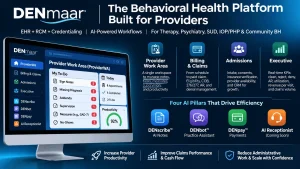
Modern platforms like behavioral health EHR systems and DENmaar are designed to unify clinical and financial workflows.
Final Thought
If you’re evaluating platforms, don’t just ask:
Does it have this feature?
Ask:
How does this feature connect to everything else in the system? Because in psychiatry, efficiency and revenue don’t come from isolated tools. They come from how well the entire workflow is integrated.The best psychiatry EHR is one that integrates documentation, scheduling, and billing into a unified system, supports AI documentation, and improves clean claims and revenue cycle management.Most systems treat billing as an add-on instead of integrating it into clinical workflows, leading to errors, denials, and lost revenue.AI helps structure notes, align documentation with billing requirements, and improve accuracy, especially when combined with systems like AI progress notes.Claims hygiene ensures that all upstream data such as documentation, eligibility, and coding are correct before submission, leading to higher clean claim rates and fewer denials.Effective RCM ensures accurate claims, faster reimbursements, and improved financial stability, especially for Medicaid and insurance-based psychiatry practices.