A Better Front Door for Behavioral Health Revenue Cycle Management
Behavioral health organizations have been trying to solve access with the wrong tools.
AI receptionists.
Chatbots.
Call routing systems.
All attempting to replicate a front desk—just with automation.
But here’s the issue:
The problem was never the front desk. It was the model.
The Old Model: Wait for the Patient to Call
Traditional systems assume:
- A patient calls or submits a form
- Staff responds
- Intake is scheduled
- Care begins
AI receptionists simply try to make that process faster.
But they don’t fix the core issue:
Many patients never call in the first place.
The Shift: Patients Enter Care Differently Now
Modern behavioral health demand looks different:
- Patients want privacy
- They explore care before committing
- They engage digitally first
- They decide later whether to identify themselves
This is where platforms like Anonymous Health change the equation.
They don’t wait for the patient to call.
They meet the patient earlier—when they’re still deciding.
Why AI Receptionists Fall Short in Behavioral Health
AI receptionist platforms still depend on:
- A triggered interaction (call, chat, form)
- A known patient identity
- A defined intake path
They operate inside the old funnel.
So even if optimized, they only improve:
What’s already happening—not what’s missing
The Real Gap: Anonymous Demand to Structured Care
There is a growing layer of demand that never reaches your system:
- Patients browsing silently
- Patients unsure about treatment
- Patients unwilling to identify yet
If your system can’t capture that:
- It never becomes a scheduled visit
- It never becomes a documented session
- It never becomes a claim
A Different Approach: Digital Engagement as the Front Door
At DENmaar, we’ve taken a different approach.
Instead of replacing front desk workflows, we rethink the entry point.
By working with technology partners like Anonymous Health, practices can:
- Capture patient engagement earlier
- Allow anonymous exploration
- Build trust before intake
This is not about automation.
It’s about access transformation.
From Engagement to Revenue: Where Most Systems Break
Most platforms stop at engagement.
They don’t answer:
- How does this patient get scheduled?
- How is care documented?
- How does this become a clean claim?
This is where fragmentation happens.
The DENmaar Model: Close the Loop
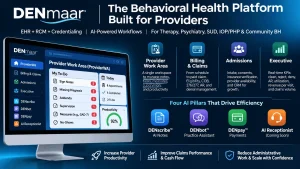
DENmaar is designed to connect the entire process through an integrated behavioral health EHR and mental health billing services:
- Digital engagement (including anonymous entry)
- Structured intake → schedulable patient
- AI-supported documentation using AI progress notes
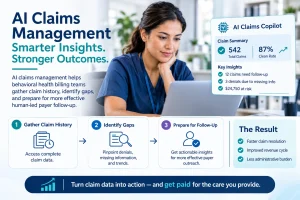
- Claim generation → submission → follow-up powered by AI in behavioral health billing
Every step is tied to revenue.
This model also integrates upstream validation through claims hygiene in behavioral health billing, ensuring clean claims and reducing denials.
Additionally, intake intelligence powered by an AI insurance card reader ensures accurate payer routing and Medicaid billing alignment from the start.
Explore the full system at DENmaar.
What This Replaces
When implemented correctly, this model replaces:
- AI receptionist platforms
- Intake coordination tools
- Disconnected patient engagement systems
Because instead of patching the front desk, you now have:
A system that converts demand directly into billable care
Why This Matters for Growing Practices
For multi-provider behavioral health groups, this shift drives:
- Faster time to first claim
- Higher conversion rates
- Increased provider utilization
- More predictable revenue growth
Who This Is Designed For
This approach is built for practices that are:
- Scaling to multiple providers
- Managing insurance-based revenue
- Looking to grow efficiently—not just add tools
It is not designed for:
- Solo-only providers
- Low-volume, self-pay-only models
Final Thought
AI receptionists try to optimize the front desk.
But behavioral health doesn’t need a better front desk.
It needs a better front door.
And once that door is open, it needs a system that can turn engagement into revenue.
That’s where the real advantage is.Not necessarily. AI receptionists improve response time, but they do not capture anonymous demand or solve upstream revenue cycle issues.A digital front-door model that captures early patient engagement and connects it to scheduling, documentation, and billing workflows.By connecting engagement to claims, practices improve clean claim rates, reduce denials, and increase revenue without adding more patients.AI supports claims hygiene, payer routing, documentation accuracy, and pre-submission validation to ensure claims are clean and payable.Because many patients explore care anonymously first. Capturing that stage increases conversion into billable services.