For all the talk about AI disrupting healthcare, the truth is this:
The first real transformation won’t be clinical — it will be administrative.
- No diagnosis.
- Not therapy.
- Not medical decision-making.
It will be the simple, relentless, daily operations that drain practices of time, energy, and money.
And nothing drains practices more than the phone.
Behavioral health practices are flooded with:
- New patient inquiries
- Cancellations and reschedules
- Medication refill requests
- Insurance and billing questions
- Administrative follow-ups
- Provider messages
- Crisis calls
- Spam robocalls
For years, no system has solved this.
Phone systems got smarter.
EHRs got prettier. But the administration workload never went down — it went up.
That changes in 2026.
What Behavioral Health Receptionists Actually Do
Most people underestimate how much invisible work receptionists carry.
A standard front desk is responsible for:
- Triage
- Data entry
- Eligibility questions
- Location & provider routing
- Patient reminders
- Phone tagging
- Refill coordination
- Rescheduling appointments
- Capturing patient demographics
- Managing insurance questions
For many practices, the front desk is the engine that keeps operations running.
But it’s also the bottleneck.
Most practices can’t scale past 5–10 providers without either:
- Overhiring reception staff, or
- Burning out the ones they have.
That’s where AI is finally mature enough to step in.
AI Receptionists Aren’t Replacing People — They’re Replacing Phone Chaos
Let’s be clear:
The AI Receptionist doesn’t eliminate humans.
It eliminates redundant tasks.
For example:
When someone calls to refill a prescription
A receptionist has to ask 5–7 required questions (name, DOB, medication, dose, pharmacy, last visit, provider).
AI can do this instantly, accurately, without fatigue — and immediately send the structured data to the clinical team.
When someone calls to cancel or reschedule
AI can capture the appointment details, reason, and route the message without interrupting a session or pulling staff away from patients.
When someone calls with an insurance question
AI can identify the caller’s intent, collect documents, and route to billing without a 10-minute phone call.
(For billing workflows, see DENmaar’s behavioral & mental health billing services.)
When a new patient calls
AI can capture name, DOB, email, insurance photos, and reason for visit — and load that directly into intake workflows.
This is not clinician replacement.
It’s administrative liberation.
2026 Will Be the Year AI Handles 60–70% of Behavioral Health Phone Traffic
We are entering the first year where AI can reliably:
- Answer calls with natural human tone
- Detect caller type
- Gather required information
- Route to the correct team
- Log the call with a clean transcript
- Handle refill requests
- Manage cancellations
- Deflect spam
- Capture insurance card images
- Support crisis routing
This is not speculative technology.
This is in-market capability — and practices are asking for it. Every day.
Why Behavioral Health Is the Perfect Place for AI Receptionists
Behavioral health has three unique challenges:
- High call volume per provider: Therapy and psychiatry generate more after-hours questions, refill requests, and admin calls than almost any other outpatient field.
- Higher no-show rates: this means more reschedules, reminders, and cancellations.
- Recurring medication management: Psychotropic meds generate constant refill and pharmacy coordination.
- Understaffed admin departments: Most practices run lean — too lean — and admin burnout is real.
AI reduces this pressure immediately.
Building the AI Receptionist at DENmaar
At DENmaar, we’re building this in phases — and focusing on the highest-value workflows first.
(For context on our AI clinical tools, see AI Treatment Planning and
AI Biopsychosocial, Treatment Planning & Progress Notes.)
Phase 1 (Release 1) — Smart Intake & Triage
- Answering calls
- Detecting intent
- Capturing required data
- Routing to intake, billing, clinical, and admin
- Handling spam
- Reliable transcripts
This alone replaces 40–50% of receptionist workload.
Phase 2 — Refill Engine
AI captures refill requests, validates required info, and routes correctly.
Phase 3 — Scheduling Assistance
AI suggests available openings, offers reschedule options, and syncs with calendars.
Phase 4 — Full Administrative Automation
From pre-auth to follow-up tracking — the receptionist becomes a 24/7 assistant.
(For credentialing workflows, see insurance credentialing services.)
The Future: The Admin-Free Practice
The end state is clear:
Providers practice. AI handles the admin.
That’s the future behavioral health deserves — and one we’re actively building at DENmaar.
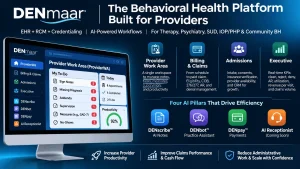
If you want to see how the AI receptionist integrates with our billing-optimized EHR, our 98% clean-claims pipeline, and our AI-powered clinical tools, reach out anytime.
2026 won’t just be another year in healthcare. It will be the year practices stop drowning in administrative work — and finally get to focus on patients again.An AI receptionist uses advanced natural language tools to answer calls, collect patient information, route messages, and automate refill and scheduling workflows for behavioral health practices.No. It replaces repetitive phone-based tasks so staff can focus on higher-value patient interactions and front-desk management.Yes. The system collects required information, verifies details, and routes structured data directly to the clinical team for review.Yes. All AI receptionist features are being built directly into DENmaar’s EHR & Billing ecosystem, ensuring seamless workflows.AI can manage reminders, reschedules, cancellations, and follow-up outreach — significantly reducing administrative load and no-show risk.