Artificial intelligence has rapidly become one of the most discussed topics in healthcare technology. Most conversations focus on one promise: creating clinical notes faster.
While speed is important, we believe the real value of AI documentation goes much deeper.
The goal is not simply to generate notes.
The goal is to produce accurate clinical documentation that reduces administrative burden, supports compliance, and gives providers more time to focus on patient care.
Accuracy Matters More Than Speed
One of the most common frustrations providers express about AI documentation solutions is the amount of editing required after a note is generated. If a provider must spend significant time correcting information, rewriting interventions, or restructuring the clinical narrative, much of the promised efficiency disappears.
Recently, a provider using DENmaar shared feedback that stood out:
“The notes are more accurate than anything else I’ve used.”
For us, this is one of the most important measures of success.
Accurate documentation means:
- Less time editing notes.
- Better reflection of the clinical encounter.
- More confidence in the medical record.
- Improved consistency across providers.
- Reduced administrative burden.
When providers trust the documentation being produced, they spend less time correcting it and more time caring for patients.
Better Documentation Creates Clinical Capacity
The impact of accurate AI documentation extends beyond note completion.
The same provider who praised the accuracy of the documentation also shared another important observation:
“I can see more patients.”
This is where AI documentation becomes transformational.
Every minute saved documenting care is a minute that can be redirected toward:
- Additional patient appointments.
- Follow-up care.
- Clinical collaboration.
- Reduced after-hours charting.
- Improved work-life balance.
For behavioral health organizations facing growing demand and provider shortages, increasing clinical capacity without increasing provider burnout is a significant opportunity.
Organizations evaluating new technology solutions often benefit from a structured validation process such as a Claims Submission Pilot Program for behavioral health organizations
Designed for the Realities of Healthcare
Healthcare documentation is not one-size-fits-all.
Each discipline has unique workflows, terminology, compliance requirements, and clinical expectations. A psychotherapy note differs significantly from a psychiatric medication management note. An intensive outpatient program session differs from a community support encounter. Substance use treatment documentation differs from outpatient therapy.
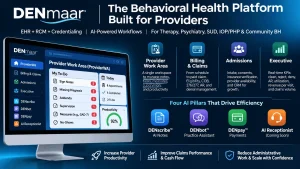
That is why DENmaar is expanding AI documentation across all disciplines served by our platform.
Our vision includes support for:
- Individual Therapy
- Family Therapy
- Group Therapy
- Psychiatric Medication Management
- Intensive Outpatient Programs (IOP)
- Substance Use Disorder Treatment
- Community-Based Services
- Case Management
- Care Coordination
- Residential Programs
- Crisis Services
- Behavioral Health Assessments
- Clinical Supervision Workflows
The goal is to create discipline-specific documentation experiences that understand the unique requirements of each service provided.
For organizations seeking comprehensive behavioral health billing services and revenue cycle support, documentation accuracy plays a critical role in clean claims, compliance, and reimbursement outcomes.
The Future of Healthcare Documentation
The future of AI documentation should not be measured solely by how quickly a note appears on the screen.
It should be measured by:
- Documentation accuracy.
- Provider confidence.
- Reduced administrative burden.
- Improved compliance.
- Increased clinical capacity.
- Better patient access to care.
When providers can trust their documentation and spend less time charting, healthcare organizations become more efficient and patients benefit from increased access to services.
For organizations serving Medicaid populations, accurate documentation is particularly important because it supports Medicaid behavioral health billing compliance, medical necessity requirements, and audit readiness:
At DENmaar, we believe AI documentation should do more than generate notes.
It should help providers practice at the top of their license, reduce burnout, and create more time for what matters most: helping patients.AI documentation reduces manual charting, improves note consistency, supports compliance requirements, and allows providers to spend more time delivering patient care.Accurate documentation reduces editing time, supports billing compliance, strengthens audit readiness, and improves provider confidence in the clinical record.Yes. By decreasing after-hours charting and administrative workload, AI-powered documentation can improve provider productivity and work-life balance.Accurate clinical notes help support medical necessity, service documentation requirements, coding accuracy, and clean claims submission for behavioral health reimbursement.AI documentation can support therapy, psychiatry, medication management, substance use treatment, intensive outpatient programs, case management, care coordination, crisis services, and behavioral health assessments.